Corrugated Transformer Tanks: Design, Manufacturing, Benefits, and Applications
Corrugated transformer tanks are widely used in oil-immersed distribution transformers because they combine oil containment, thermal expansion compensation, and heat dissipation within a compact steel structure.
Their flexible corrugated walls expand and contract as transformer oil volume changes, helping the transformer operate safely under varying load and temperature conditions.
Compared with conventional rigid tank designs, corrugated transformer tanks can reduce the need for separate radiators and external expansion systems in suitable applications. This makes them an efficient solution for transformer manufacturers, utilities, renewable energy projects, industrial facilities, and distribution networks that require compact construction, reliable cooling, and long service life.
Corrugated Transformer Tanks for Power and Distribution Transformer Applications
Corrugated transformer tanks engineered for efficient cooling, oil-volume compensation, and reliable long-term operation.
This guide explains how corrugated transformer tanks work, how they are designed and manufactured, which materials are commonly used, their key benefits, typical applications, and the main factors to consider when selecting a suitable tank.
What Are Corrugated Transformer Tanks?
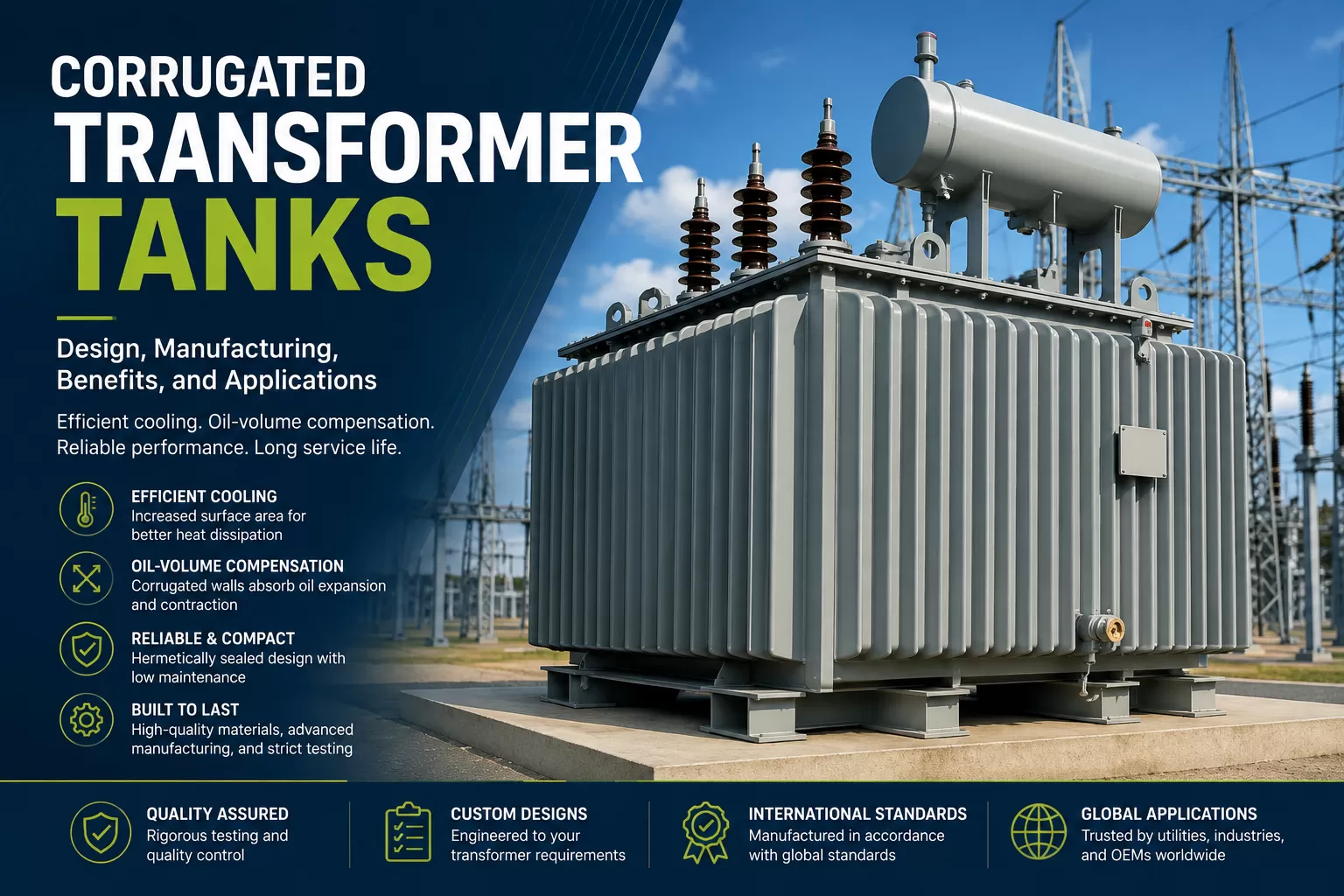
Corrugated transformer tanks are steel enclosures designed to house the core, windings, insulating oil, and auxiliary components of oil-immersed transformers. Their side walls are formed with vertical corrugations, creating flexible cooling surfaces that respond to oil-volume changes caused by temperature fluctuations.
In a hermetically sealed transformer, the insulating oil is isolated from the atmosphere. As the oil temperature rises, the oil expands and the corrugated walls move outward. When the transformer cools, the oil contracts and the walls return toward their original position. This controlled movement allows the tank to compensate for oil expansion without requiring a separate conservator in many distribution-transformer applications.
Primary Functions of a Corrugated Transformer Tank
- Protecting the transformer core, windings, and internal components
- Containing insulating oil safely and preventing contamination
- Dissipating heat generated during transformer operation
- Compensating for changes in transformer oil volume
How Corrugated Transformer Tanks Work
During transformer operation, electrical losses in the core and windings generate heat. This heat is transferred to the insulating oil, which circulates naturally inside the tank. The heated oil rises, moves toward the tank walls, releases heat to the surrounding air, and then returns to the lower sections of the tank as it cools.
The corrugated panels increase the external surface area of the tank. A larger heat-transfer area helps improve natural cooling performance without significantly increasing the overall footprint of the transformer.
Thermal Expansion Compensation
Transformer oil expands as temperature increases and contracts as temperature decreases. The flexible corrugated walls are designed to accommodate these changes. Their movement helps control internal pressure and supports hermetically sealed operation.
Natural Cooling
Corrugated panels act as integrated cooling surfaces. Heat moves from the oil to the steel panels and then to the surrounding air through natural convection and radiation. In many distribution-transformer designs, this reduces or eliminates the need for separate radiator assemblies.
Environmental Isolation
In a hermetically sealed system, the insulating oil does not come into direct contact with outside air. This helps reduce moisture ingress, oil oxidation, and contamination, supporting consistent insulation performance over time.
Key Benefits of Corrugated Transformer Tanks
Efficient Cooling Performance
The corrugated geometry increases the available cooling surface and improves natural heat dissipation. This helps control operating temperatures and protect insulation materials from excessive thermal stress.
Compact Construction
Corrugated walls combine the functions of a tank body, cooling surface, and expansion compensation system. Integrating these functions can reduce the number of external components and support a more compact transformer design.
Reduced Maintenance Requirements
Hermetically sealed corrugated tanks limit contact between the insulating oil and the atmosphere. Lower exposure to oxygen and moisture can reduce oil degradation and decrease maintenance requirements.
Lower Risk of Oil Contamination
A properly sealed corrugated tank helps prevent dust, humidity, and airborne contaminants from entering the transformer. This supports stable dielectric performance and long-term reliability.
Long Service Life
When manufactured with suitable steel, qualified welding procedures, effective corrosion protection, and rigorous quality control, corrugated transformer tanks can remain in reliable service for decades.
Flexible Customization
Corrugated transformer tanks can be customized according to transformer rating, oil volume, dimensional limits, cooling requirements, connection points, lifting arrangements, and customer specifications.
Design Considerations for Corrugated Transformer Tanks
The design of a corrugated transformer tank must account for structural strength, thermal behavior, oil-volume changes, internal pressure, transportation loads, and manufacturing tolerances.
Transformer Rating and Oil Volume
The required tank volume and corrugated surface area depend on the transformer power rating, internal active-part dimensions, insulation clearances, and total oil volume.
Cooling Requirements
The number, depth, height, and spacing of the corrugations influence heat-transfer performance. These parameters should be determined according to expected losses, ambient conditions, and required temperature-rise limits.
Pressure and Vacuum Resistance
The tank must withstand internal pressure changes during operation, filling, testing, and transportation. Where vacuum filling or vacuum drying is required, the design must also provide sufficient resistance to external pressure.
Mechanical Strength
Structural calculations should consider the weight of the active part, insulating oil, cover, bushings, accessories, lifting forces, jacking loads, transport acceleration, and possible seismic requirements.
Oil Tightness
Weld joints, fittings, flanges, valves, and cover connections must be designed and manufactured to minimize leakage risk. Oil tightness is one of the most important quality requirements for transformer tanks.
Corrosion Protection
Surface preparation and coating selection should reflect the installation environment. Indoor, outdoor, coastal, industrial, humid, and highly corrosive environments may require different paint systems and coating thicknesses.
Transportation and Installation
Tank dimensions, lifting lugs, jacking points, towing provisions, base channels, and transport supports should be designed according to project logistics and installation requirements.
Materials Used in Corrugated Transformer Tanks
Corrugated transformer tanks are generally manufactured from high-quality steel sheets selected according to structural, forming, welding, and corrosion-resistance requirements.
Common Material Options
- Carbon steel
- Low-alloy structural steel
- Cold-rolled steel sheets for corrugated panels
- Hot-rolled steel sheets for structural sections
- Stainless steel for specialized applications
- Galvanized or corrosion-protected steel where specified
Material thickness varies according to tank size, panel geometry, internal pressure, transformer rating, and customer requirements. The selected material must provide sufficient strength while remaining suitable for forming, bending, and welding operations.
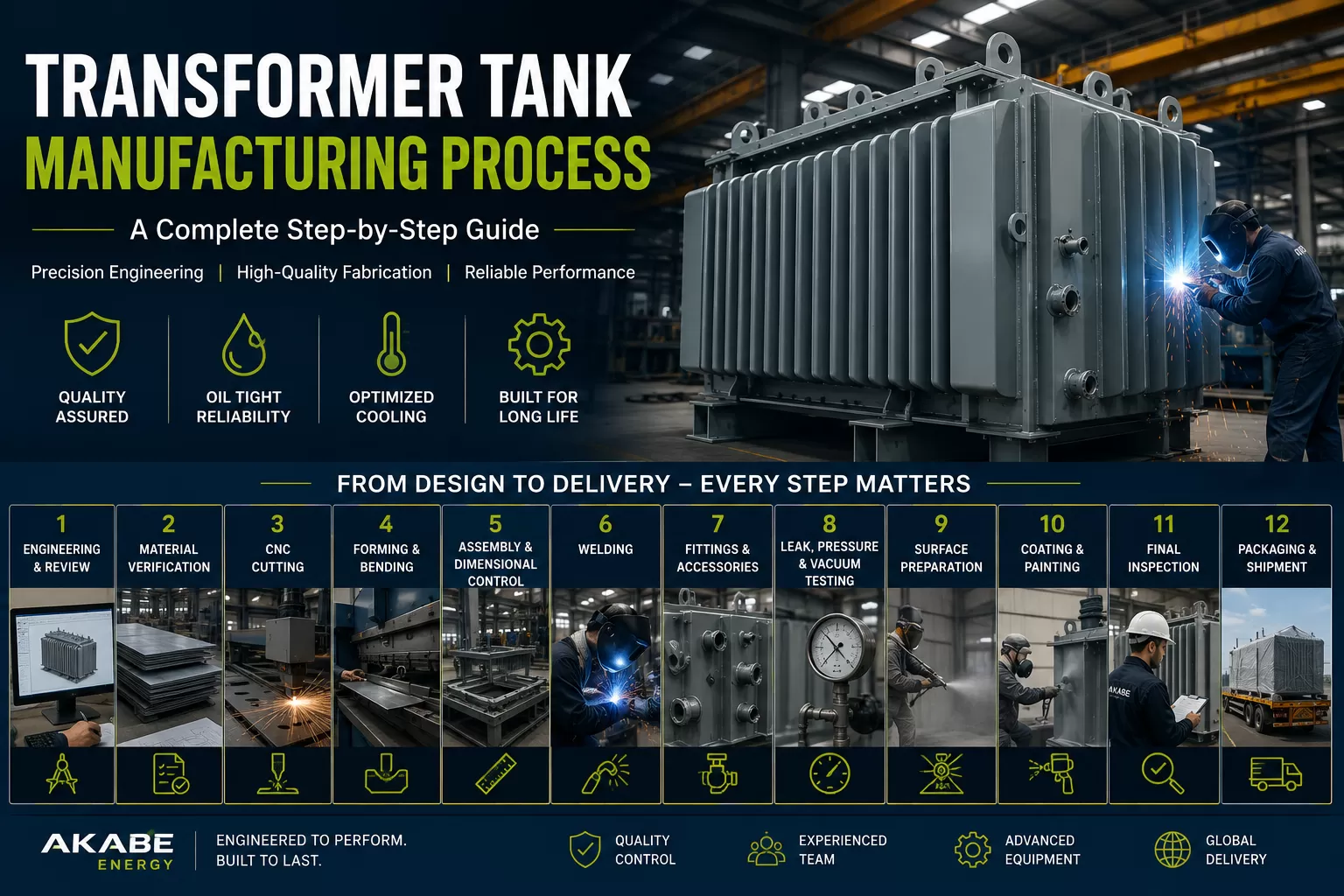
Corrugated Transformer Tank Manufacturing Process
Manufacturing a corrugated transformer tank requires controlled engineering, forming, welding, surface treatment, and inspection stages. Consistency at every stage is essential for dimensional accuracy, cooling performance, mechanical reliability, and oil tightness.
1. Engineering Design
The process begins with detailed production drawings and structural calculations. Tank dimensions, corrugation geometry, oil volume, cooling area, fittings, lifting points, and connection details are defined during this stage.
2. Steel Sheet Cutting
Steel sheets are cut using CNC laser, plasma, or other precision cutting systems. Accurate cutting reduces assembly errors and supports consistent welding quality.
3. Corrugation Forming
Corrugated panels are formed using specialized fin-folding or corrugation-forming machines. Panel depth, pitch, height, and profile must remain consistent to provide predictable mechanical and thermal performance.
4. Forming and Bending
Base plates, frames, covers, flanges, brackets, and reinforcement components are shaped using CNC press brakes according to approved manufacturing drawings.
5. Assembly and Welding
Corrugated panels and structural components are assembled using fixtures that help maintain dimensional accuracy. Certified welders or automated welding systems apply qualified welding procedures to create strong, oil-tight joints.
6. Installation of Fittings and Accessories
Depending on the transformer design, the tank may include valves, thermowells, earthing terminals, lifting lugs, jacking pads, drain connections, filter valves, pressure-relief connections, and other customer-specific fittings.
7. Leak and Pressure Testing
Before surface coating, the tank is tested to confirm oil tightness and structural performance. Testing methods may include air-pressure testing, liquid-penetrant inspection of selected welds, soap-solution testing, or other project-specific leak-detection procedures.
8. Surface Preparation
Steel surfaces are cleaned by shot blasting, sandblasting, or another specified method. Proper surface preparation removes rust, mill scale, oil, and contaminants while creating a suitable profile for coating adhesion.
9. Protective Coating
Industrial primer, intermediate coats, and topcoats are applied according to the required corrosion category, color specification, dry-film thickness, and service environment.
10. Final Inspection
Final inspection confirms that the completed tank meets project requirements before delivery.
- Dimensional accuracy
- Corrugation consistency
- Weld quality
- Leak integrity
- Surface finish
- Coating thickness
- Position and dimensions of fittings
- Compliance with approved drawings
Testing and Quality Control
Quality control is essential because defects in the transformer tank can affect oil containment, cooling performance, safety, and transformer service life.
Dimensional Inspection
Overall dimensions, mounting points, flange positions, cover alignment, corrugated panel geometry, and accessory locations are checked against approved drawings.
Weld Inspection
Welds are visually inspected for discontinuities, incomplete fusion, undercut, porosity, cracks, and other defects. Additional non-destructive testing methods may be used where required.
Leak Testing
Leak testing verifies that the tank can safely contain insulating oil throughout its service life. Particular attention is given to welded seams, fittings, flanges, and corrugated-panel connections.
Coating Inspection
Surface cleanliness, coating appearance, adhesion, and dry-film thickness may be inspected according to project requirements.
Documentation and Traceability
Material certificates, inspection records, test reports, welding documentation, and coating records may be maintained to support traceability and customer quality requirements.
Applications of Corrugated Transformer Tanks
Corrugated transformer tanks are primarily used in oil-immersed distribution transformers and compact power transformer applications where natural cooling, hermetic sealing, and space efficiency are important.
Typical Applications
- Distribution transformers
- Hermetically sealed transformers
- Pad-mounted transformers
- Pole-mounted transformers
- Renewable energy projects
- Solar power plants
- Wind farms
- Industrial power systems
- Electrical substations
- Mining facilities
- Commercial and infrastructure projects
- Utility distribution networks
How to Choose the Right Corrugated Transformer Tank
Selecting the correct corrugated transformer tank requires coordination between the transformer designer, tank manufacturer, and end customer.
Important Selection Criteria
- Transformer power rating
- Active-part dimensions
- Total insulating oil volume
- Expected transformer losses
- Required cooling surface area
- Ambient temperature range
- Installation altitude
- Internal pressure and vacuum requirements
- Corrosion category and coating specification
- Transportation limitations
- Lifting and installation requirements
- Customer and project specifications
An experienced corrugated transformer tank manufacturer can evaluate these factors and develop a solution that meets structural, thermal, dimensional, and operational requirements.
Why Choose Akabe Energy for Corrugated Transformer Tanks?
Akabe Energy provides corrugated transformer tanks engineered for the requirements of power and distribution transformer manufacturers. Each project can be developed according to approved drawings, technical specifications, operating conditions, and customer-specific requirements.
Key Manufacturing Capabilities May Include
- Custom tank design and engineering support
- Precision steel cutting and forming
- Controlled corrugated-panel production
- Qualified welding processes
- Leak and pressure testing
- Industrial surface preparation
- Corrosion-resistant coating systems
- Dimensional and final quality inspection
Looking for Corrugated Transformer Tanks?
Contact Akabe Energy to discuss your transformer rating, dimensions, oil volume, cooling requirements, coating specification, and project delivery needs.
Frequently Asked Questions About Corrugated Transformer Tanks
What is a corrugated transformer tank?
A corrugated transformer tank is a steel enclosure with flexible corrugated walls that houses transformer components, contains insulating oil, dissipates heat, and compensates for oil-volume changes.
How do corrugated transformer tanks support cooling?
Their corrugated panels increase the external surface area of the tank, improving natural heat transfer from the transformer oil to the surrounding air.
Why are corrugated tanks used in hermetically sealed transformers?
Flexible corrugated walls expand and contract as the insulating oil volume changes, allowing the tank to compensate for thermal expansion while keeping the oil isolated from the atmosphere.
Which materials are used to manufacture corrugated transformer tanks?
Corrugated transformer tanks are commonly manufactured from carbon steel or low-alloy steel sheets selected according to forming, welding, strength, and corrosion-resistance requirements.
Do corrugated transformer tanks require separate radiators?
Not always. In many distribution-transformer designs, the corrugated panels provide sufficient cooling surface. Separate radiators may still be required for higher losses or specific operating conditions.
Can corrugated transformer tanks be customized?
Yes. Tank dimensions, panel geometry, fittings, lifting points, base structure, coating system, and other features can be customized according to transformer and project requirements.
How are corrugated transformer tanks tested?
They are commonly subjected to dimensional inspection, weld inspection, leak testing, pressure testing, coating inspection, and final verification against approved drawings and project specifications.