14 Nov 2026
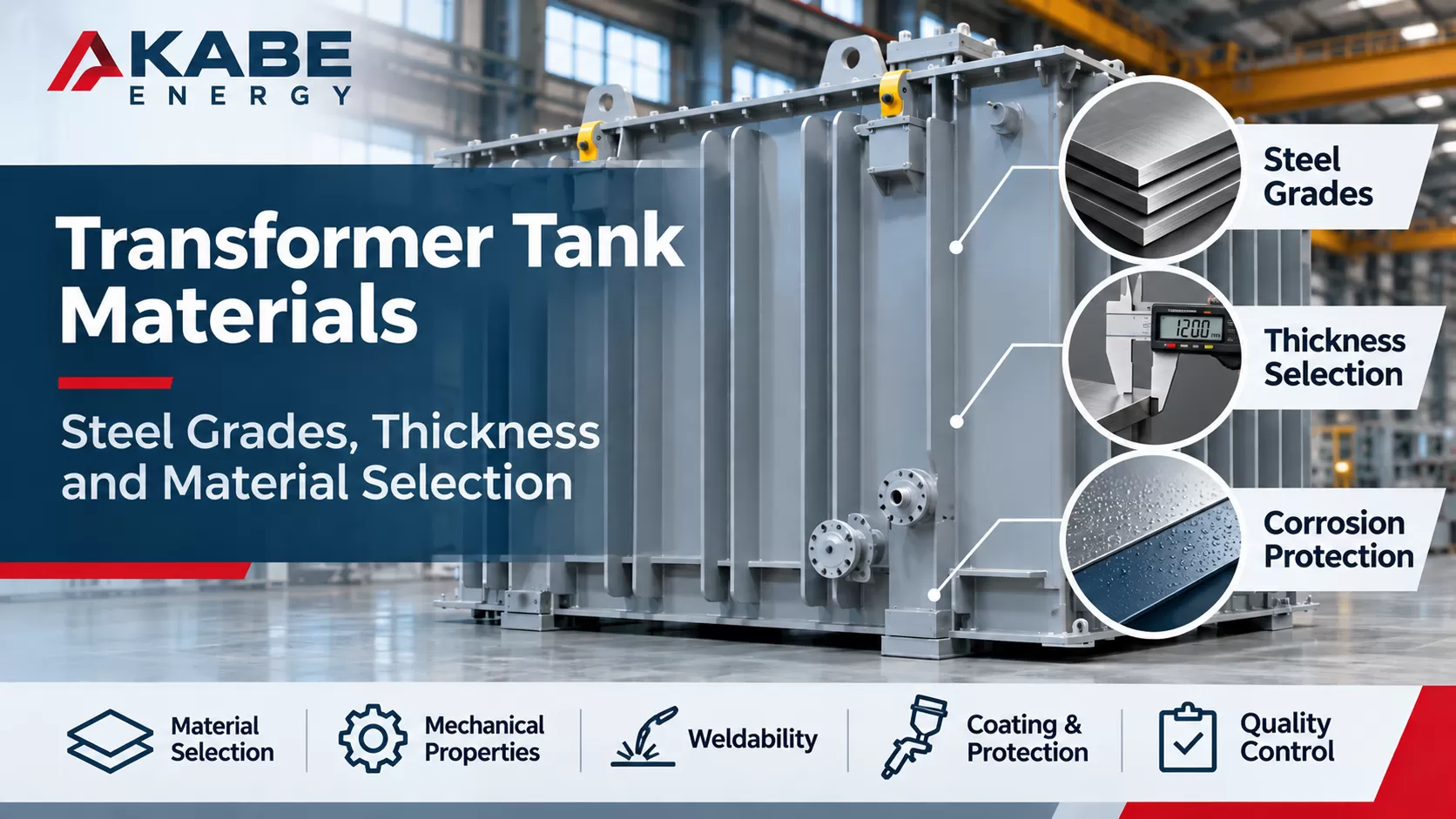
Discover how to select transformer tank materials, compare steel grades and determine plate thickness. Learn about mechanical properties, weldability and corrosion protection.
A practical engineering guide to steel selection, plate thickness, mechanical properties, corrosion protection, welding compatibility and material quality control in transformer tank manufacturing.
Material selection is a fundamental part of transformer tank engineering. The tank must provide a mechanically robust enclosure for the transformer’s active components, contain insulating liquid where applicable, support accessories and withstand the loads defined by the design. The selected material therefore affects structural performance, fabrication, weldability, corrosion protection, dimensional stability and total manufacturing cost.
There is no single steel grade or plate thickness that is correct for every transformer tank. Requirements vary with tank geometry, transformer rating, oil volume, design pressure and vacuum conditions, installation environment, manufacturing process and customer specification. Material decisions should be made against approved drawings and engineering calculations rather than by applying a universal rule.
A transformer tank faces different demands throughout its lifecycle. During manufacturing, steel must be cut, formed, fitted and welded without unacceptable defects or distortion. In service, the completed structure must withstand its specified mechanical and environmental conditions. During transportation and installation, lifting points, supports and mounting interfaces must carry their design loads.
An unsuitable material can increase forming difficulty, welding risk, corrosion exposure or weight. A material with properties beyond the actual design need may add cost without meaningful benefit. Effective selection balances engineering requirements, availability, process capability and lifecycle considerations.
Carbon steel is widely used in fabricated industrial enclosures and is a common candidate for transformer tank construction. It offers a practical combination of strength, formability, weldability and availability across a range of product forms and thicknesses. The exact grade should be selected according to required mechanical properties, delivery condition, thickness range and applicable product standard.
For many tank designs, carbon steel can provide the required performance when supported by suitable structural design, fabrication controls, inspection and protective coating. A grade commonly used in general fabrication is not automatically suitable for a particular tank: material certificates and design requirements must be checked.
Some projects may consider low-alloy or higher-strength grades where the design calls for particular mechanical properties or weight optimization. Higher strength does not automatically mean a better tank. Forming behavior, welding procedure qualification, heat input, toughness requirements and availability must also be evaluated. Proposed substitutions require approval by the responsible design authority.
Stainless steel may be considered for specialized environments or applications where corrosion resistance is required by the specification. It is generally more expensive than conventional carbon steel and may involve different forming, welding, finishing and joining considerations. It should not be assumed necessary for every tank; the environment, coating strategy and customer requirements determine whether it is justified.
The choice is not simply a comparison of strength. It is a system-level decision involving exposure conditions, fabrication, maintenance and cost.
For many conventional outdoor installations, a properly specified carbon-steel tank with a suitable coating system may be effective. More aggressive environments may justify alternative materials or enhanced protection. The decision should be supported by project-specific engineering and lifecycle considerations.
Steel grades are defined by product standards and designations specifying chemical composition, mechanical properties, delivery conditions and dimensional tolerances. Depending on the market and project, procurement specifications may reference EN, ASTM or other recognized material standards. Examples of structural steel designations encountered in industry include S235 and S355 families under relevant EN product standards, and ASTM A36 in some markets.
Engineers typically review yield strength, tensile strength, elongation, toughness where specified, chemical composition, carbon equivalent where relevant to welding, and thickness-dependent property requirements. Design calculations must use properties applicable to the actual product and thickness.
Plate thickness is determined by engineering requirements rather than by a universal industry value. It may depend on panel dimensions, unsupported spans, stiffener spacing, internal and external pressure conditions, vacuum requirements, handling loads, accessory loads, corrosion allowance where specified and manufacturing tolerances.
Tank walls, base plates, covers, stiffeners and corrugated panels may have different thickness requirements because they perform different structural functions. A flat panel with a large unsupported span may require a different arrangement from a formed corrugated panel. A cover carrying bushings or other equipment may need local reinforcement based on design loads.
Reducing thickness to lower weight or cost must never be done without engineering review. A change can affect deflection, buckling resistance, weld design, vibration behavior, lifting arrangements and test performance. Final thicknesses must be established by the approved design and verified against the purchase specification.
Corrugated tank panels are formed into a profile that contributes to structural behavior and, in many designs, supports heat dissipation and changes in oil volume. Material selection must consider both mechanical properties and the ability to form the specified geometry consistently.
The sheet must be suitable for forming without unacceptable cracking, thinning or profile variation. Formability depends on grade, thickness, rolling direction, mechanical properties, tooling, bend radii and process settings. Trial forming and inspection may be appropriate when a new grade, thickness or panel design is introduced.
After forming, panels should be checked against approved dimensions and profile tolerances. Welding to adjacent components should follow qualified procedures that control heat input and distortion. Material certificates and batch traceability should be maintained through cutting, forming and assembly.
Yield strength indicates the stress at which permanent deformation begins under the defined test method, while tensile strength describes the maximum stress reached during a tensile test. Both inform structural design, but neither should be used in isolation. Geometry, load cases and applicable design rules remain essential.
Elongation provides an indication of ductility under a tensile test. Bending and corrugation require suitable ductility and material consistency. Actual formability also depends on thickness, rolling direction, tooling and process conditions.
Where specified, impact toughness can be important for low-temperature service or particular loading risks. Chemical composition influences material behavior and weldability. Requirements should be taken from the governing material standard and project specification.
Carbon steel can corrode when exposed to moisture, oxygen, salts and other environmental contaminants. Transformer tank protection commonly involves a specified surface-preparation and coating system selected for the installation environment and expected service conditions.
The coating specification may define surface cleanliness, surface profile, primer and topcoat types, dry-film thickness, curing conditions, inspection methods and repair procedures. Edges, welds, corners and difficult-to-access areas deserve particular attention because coating coverage can be challenging in these locations.
Stainless steel may reduce corrosion risk in certain environments, but it is not immune to every form of corrosion and still requires correct grade selection and fabrication. Material choice and coating design should be considered together.
The selected steel must be compatible with the intended welding process and qualified welding procedures. Relevant considerations include chemical composition, thickness, joint design, restraint, preheat where required, filler-metal selection and heat input. Carbon equivalent or other weldability indicators may be used where relevant to assess cracking risk, but they do not replace procedure qualification or engineering judgment.
Material substitutions should be reviewed before fabrication. A change in grade or thickness can affect welding parameters, forming behavior, distortion, inspection requirements and the validity of existing procedure qualifications. Procurement, engineering and quality teams should ensure that approved material revisions are communicated to production.
The purchase specification should identify the applicable material standard, grade, product form, thickness, delivery condition, inspection requirements and documentation. Depending on the project, standards from organizations such as EN or ASTM may be referenced. The exact standard and edition should be stated in the contract documents.
Material test certificates provide evidence of specified chemical and mechanical test results for the supplied product. The required certificate type and content should be defined by the purchase order or quality plan. A certificate should be checked for consistency with material marking, heat or batch number, dimensions and delivered quantity.
No single material certificate or standard automatically demonstrates that a completed tank complies with every design, welding, coating or testing requirement. Material conformity is one part of the overall quality process.
Incoming material inspection helps prevent incorrect or nonconforming steel from entering production. A practical control process may include:
Additional testing or independent verification may be required by the project specification, risk assessment or purchaser. Inspection scope should be agreed before procurement so documentation and hold points are clear.
A supplier and purchaser should evaluate material selection against the complete project context. Important questions include:
The most suitable material is the one that meets verified technical requirements while remaining practical to manufacture, inspect, protect and procure.
For buyers evaluating a transformer tank manufacturer, material management is an important part of supplier qualification. Discussions should cover how the supplier reviews customer drawings, confirms material specifications, verifies incoming steel, maintains traceability and controls approved changes during production.
Akabe Energy customers can provide the project’s technical specification, drawings, required standards, environmental conditions and inspection-documentation expectations as the basis for a project-specific material review. Any particular steel grade, thickness range, certificate type or manufacturing capability should be confirmed directly against the requirements of the individual project.
A clear material specification at the quotation stage helps reduce ambiguity, supports accurate costing and creates a common reference for procurement, fabrication and final inspection.
Carbon steel is commonly considered because of its availability and fabrication characteristics. Stainless steel or other materials may be specified for particular environments or project requirements.
There is no single best grade for every design. The grade must satisfy the approved structural design, product standard, thickness range, forming and welding requirements, and customer specification.
There is no universal standard thickness. It depends on tank geometry, pressure and vacuum requirements, loads, stiffeners, forming process and approved engineering calculations.
Yes, where justified by the design and project specification. Its corrosion resistance, cost, welding and fabrication requirements should be evaluated for the intended application.
They provide traceable evidence of specified chemical and mechanical properties and help verify that supplied steel matches purchase requirements.
No. Higher strength alone does not guarantee better performance. Formability, weldability, toughness, corrosion protection, design and total cost must also be considered.
Grade, chemical composition, thickness and joint design influence procedure selection, heat input, consumables and potential cracking risks. Qualified procedures and approved material controls are essential.
Transformer tank material selection is an engineering decision that affects structural performance, manufacturability, weld quality, corrosion protection and project cost. Carbon steel is a common option for many designs, while stainless or higher-strength materials may be appropriate when justified by specific requirements. Steel grade and plate thickness must always be selected against the approved design, applicable standards and customer specification.